 Save
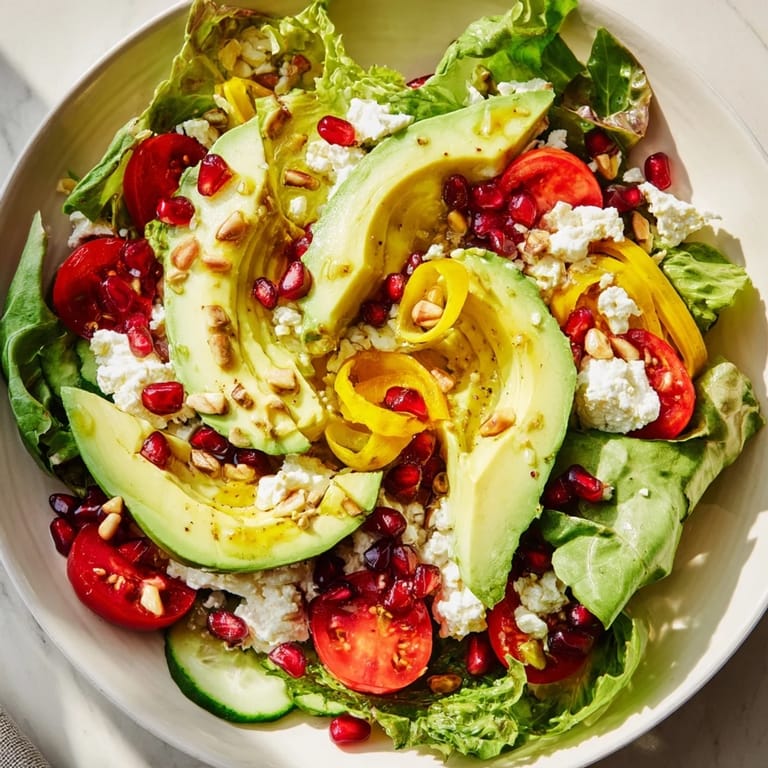
Save I discovered this salad one afternoon while sketching designs in my kitchen notebook, doodling spirals and curves without thinking. My eye kept landing on the vegetables I'd arranged on the counter—the way a ripe avocado's curve echoed the sweep of bell pepper strips, how the pomegranate seeds naturally clustered like a focal point. That's when it hit me: what if I built a salad the way nature builds things, following those invisible mathematical lines that make us pause and say "that's beautiful." The result was this Golden Ratio Salad, proof that the best recipes often start with simply paying attention.
I made this for a dinner party where I'd invited people I didn't know very well yet. I was nervous, honestly—would the salad be enough? But the moment I set that platter down and everyone went quiet, leaning in like they were seeing something almost hypnotic, I realized food doesn't have to be complicated to feel generous. Someone asked if it was too pretty to eat, and we all laughed before diving in. That's when salads stopped feeling like an obligation and became something I actually looked forward to making.
Ingredients
- Mixed baby greens (arugula, spinach, watercress): Use about 4 cups as your foundation—this mix gives you peppery notes, earthiness, and delicate texture that doesn't wilt the second you look at it.
- Cherry tomatoes: Halve 1 cup; their sweetness balances the sharp greens and their ruby color is honestly the hero of the presentation.
- Ripe avocado: One sliced just before assembly—slice it right over the salad to minimize browning and catch that moment when the flesh is still pale green.
- Yellow bell pepper: Slice it thin, 1 pepper total; the color contrast against the greens and the natural sweetness matter more here than volume.
- Cucumber: One small one, thinly sliced, adds a cool crunch that keeps things from feeling heavy.
- Pomegranate seeds: Use 1/2 cup; they're the punctuation marks that catch light and add little bursts of tart sweetness.
- Feta cheese: 1/2 cup crumbled; the saltiness wakes everything up without overwhelming the delicate vegetables.
- Toasted pine nuts: 1/4 cup; toast them yourself in a dry pan for two minutes if you can—the smell alone is worth it, and they'll taste fresher.
- Extra-virgin olive oil: 3 tablespoons of the good stuff; this is not the time to use the kitchen-sink bottle.
- Lemon juice: Squeeze 1 fresh lemon for 1 tablespoon; bottled just doesn't have the brightness.
- Honey: 1 teaspoon rounds out the dressing's edges and adds a whisper of richness.
- Dijon mustard: Just 1/2 teaspoon acts as an emulsifier and brings a subtle sophistication to the dressing.
Tired of Takeout? 🥡
Get 10 meals you can make faster than delivery arrives. Seriously.
One email. No spam. Unsubscribe anytime.
Instructions
- Build your canvas:
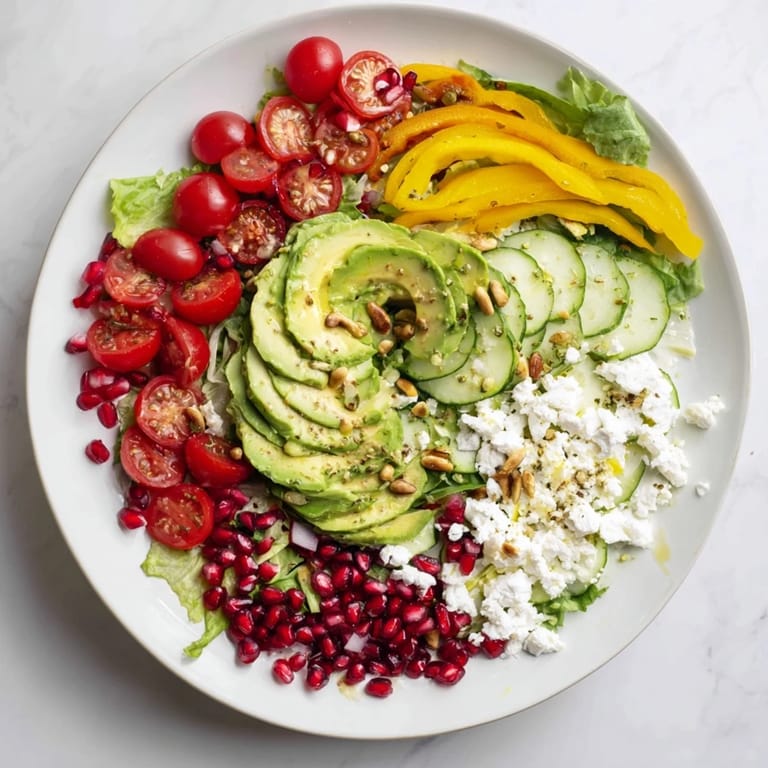
- Spread the mixed greens across a large platter in a gentle spiral or sweeping curve—don't overthink it, just let your hand move naturally. This creates depth and gives you room to work.
- Place the stars:
- Starting near the center focal point of your platter (roughly where the Golden Ratio would place it, though honestly just trust your eye), begin arranging the larger elements—avocado slices, tomato halves, pepper strips. Space them so you can still see the greens underneath, and let each piece have a little breathing room.
- Fill the spiral:
- As you move outward from the center, layer in the cucumber slices and pomegranate seeds, letting them follow the curve you've created. The arrangement should feel like it's spiraling gently outward, not cramped.
- Dot with feta and nuts:
- Scatter the crumbled feta and toasted pine nuts across the salad, adding a bit more concentration near the center focal point to guide the eye. These bits of richness anchor the whole composition.
- Whisk the dressing:
- In a small bowl, add olive oil, lemon juice, honey, Dijon mustard, salt, and pepper—whisk until the mustard acts as an emulsifier and everything comes together with a slight sheen. Taste and adjust; the dressing should make your lips pucker just slightly, then bloom with warmth.
- The dramatic finish:
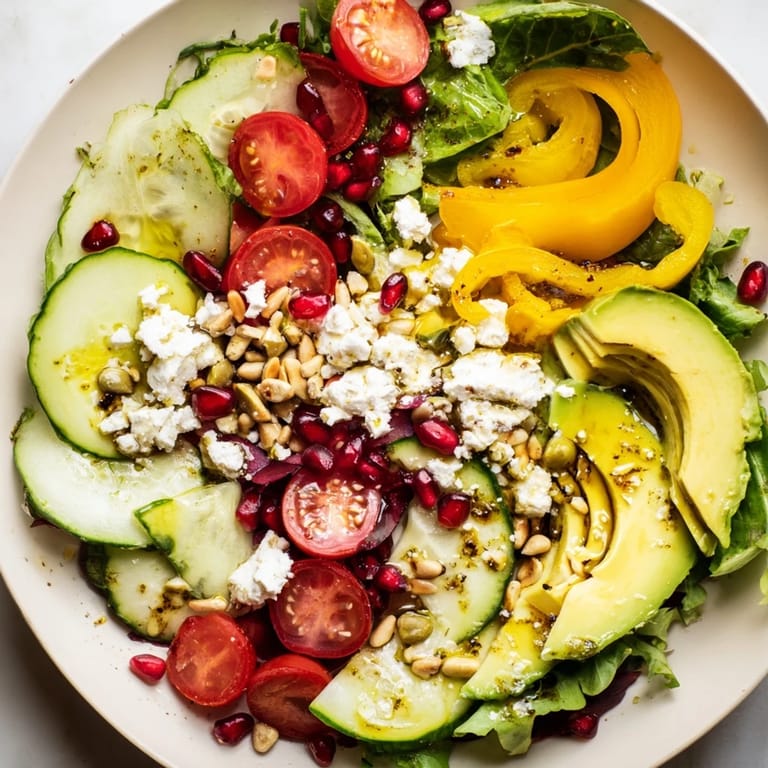
- Just before serving, drizzle the dressing lightly across the salad in a gentle pattern—you want people to taste it, not drown in it. Set it down and resist the urge to fuss; let the arrangement speak.
 Save
Save One of my favorite memories with this salad happened when my partner watched me carefully arrange each ingredient and asked, "Aren't you just going to eat it?" I had to laugh at myself—yes, of course—but in that moment I realized that food can be both beautiful and nourishing, that taking time to make something look like you care actually makes you care more. We sat there, the platter between us, and somehow eating felt like a conversation.
The Story Behind the Golden Ratio
The Golden Ratio has mesmerized humans for centuries—it appears in seashells, sunflowers, even the proportions of our own faces. When I started thinking about applying it to food, I realized that the ratio wasn't just mathematical; it was intuitive. Our eyes naturally find balance and beauty in proportion, and a salad arranged with intention becomes something we actually want to sit down and eat. There's something about honoring that natural geometry that makes a simple salad feel almost ceremonial, without any pretension.
Why Aesthetics Matter in the Kitchen
I used to think plating was show-off stuff, reserved for restaurants and fancy dinners. Then I realized that when food is beautiful, we slow down. We notice flavors we might have rushed past. We share it differently. A salad in a bowl is functional; a salad arranged thoughtfully on a platter is an experience. This doesn't mean you need special skills—it just means you're paying attention, and that attention translates into better meals and better moments.
Making It Your Own
The genius of this salad is that the framework stays the same but your ingredients can shift with the seasons and what's in your garden or market. In summer, pile on heirloom tomatoes and fresh herbs. In fall, swap the feta for goat cheese and add roasted beets. The spiral and focal point stay; everything else is yours to play with. Once you understand the principle—building outward from a center point with intention—you can build infinite versions of this.
- Add grilled chicken or chickpeas for protein without losing the visual drama.
- Substitute goat cheese for feta if you want something creamier and less salty.
- Toast your pine nuts fresh if you can; even two minutes in a dry pan elevates the whole salad.
 Save
Save This salad has taught me that the most memorable meals aren't always the most complicated—they're the ones made with intention and shared with people you want to slow down for. Every time I make it, I remember that dinner party, and I'm reminded that feeding people, at its heart, is just about paying attention.
Recipe FAQs
- → What greens work best for this salad?
Mixed baby greens like arugula, spinach, and watercress provide a fresh and varied base with peppery and mild flavors.
- → How is the Golden Ratio applied in the presentation?
Ingredients are arranged following a spiral or sweeping curve, focusing larger items near the 61.8% point to create visually pleasing balance.
- → Can I substitute feta cheese?
Yes, goat cheese can be used as a creamy alternative to feta while maintaining tangy notes.
- → What dressing complements the salad?
A simple mix of extra-virgin olive oil, lemon juice, honey, Dijon mustard, salt, and pepper enhances flavors without overpowering.
- → Are there recommended pairings with this dish?
Light white wines such as Sauvignon Blanc or sparkling wines pair exceptionally well with the fresh, crisp elements.